Roof Lanterns: What to Consider Before You Buy
12 August 2026The short answer: a roof lantern is a glazed structure that sits on a builder-formed upstand on a flat roof, so the two decisions that matter most are made before anyone quotes for glass. Get the upstand and the structural opening right, and the lantern itself is the straightforward part.
Most of the problems we are called out to look at are not lantern problems. They are kerb problems, drainage problems, or a lantern ordered before the builder knew what size to build to. This is what to settle first.
What is the difference between a roof lantern and a rooflight?
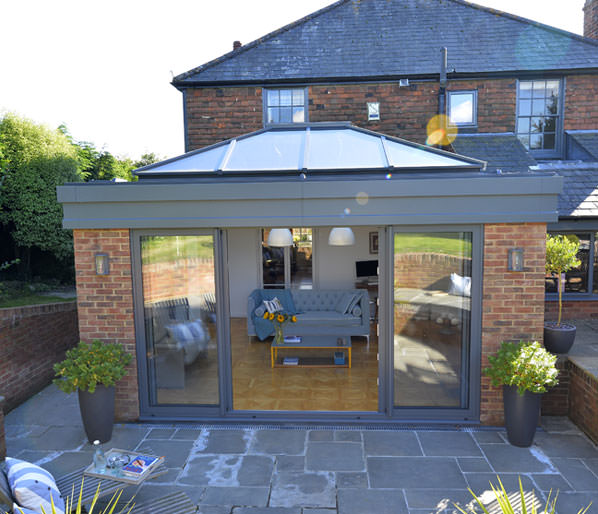
A roof lantern is a raised, pitched structure with a ridge, built up from a kerb, and it projects above the roof line. A rooflight, or flat rooflight, sits flush or nearly flush with the roof and has no pitched form.
The practical difference is character and daylight. A lantern gives a room a sense of height and pulls light in from several angles as the sun moves. A flat rooflight is more discreet and suits a contemporary extension where you do not want anything projecting. Both work. It is an architectural decision more than a technical one.
What has to be right before you order?
The kerb, or upstand
The lantern does not sit on the flat roof itself. It sits on a raised kerb that the builder forms, usually in timber, and that kerb is what determines the finished size. The lantern is made to the kerb, not the other way round, so the kerb must be built square, level and to an agreed dimension. Confirm whether the quoted size is the external kerb size or the internal aperture, because getting that wrong by a few centimetres is expensive.
Drainage
Water has to leave the roof somewhere, and the kerb is now in its way. The falls on the flat roof and the position of the outlet need to be planned around the lantern rather than after it. This is a roofing question, but it is the one that causes leaks later if nobody owns it.
The structural opening
Cutting an opening in a roof affects how loads travel. Whether you need new trimmers, and what size, is a question for whoever is doing the structural work. Do not order glass until that is settled.
Do I need building regulations approval?
Almost certainly, yes, if you are forming a new opening in a roof or building an extension. Building regulations cover structure, thermal performance and, where relevant, safety glazing, and a new roof opening engages all three.
Planning permission is a separate question from building regulations, and it depends on your property, what you are doing, and whether you are in a conservation area or the property is listed. We are installers rather than a planning consultancy, so the reliable answer comes from your local authority or your architect. Ask before you commit to a design, not after.
How big can a roof lantern be?
Larger than most people expect, but the limit is a combination of the system, the glass unit size, and what the structure below can carry. Very large lanterns may need an intermediate rafter, which changes the look, so if an uninterrupted span matters to you, say so early and let it drive the specification.
The honest answer for your project comes from a survey, because it depends on the opening and the structure. We would rather tell you what is achievable on site than quote a maximum in the abstract.
What about heat and glare?
A roof lantern faces the sky, so it collects more solar gain than a vertical window of the same area. In a south-facing room that is wonderful in March and can be uncomfortable in July.
The lever you have is the glass. Solar control coatings reduce how much heat comes through while keeping the light, and the specification can be tuned to the orientation of the room. Discuss the aspect of the room when you are choosing glass rather than treating glazing as a single default option. The same goes for winter heat loss, where the glass unit and the frame both matter.
Which system do you install?
We install aluminium lantern roofs using the Atlas system, and our installers are trained directly on it. You can see a completed example on our Haywards Heath roof lantern project.
Common questions
Can a roof lantern be fitted to a pitched roof?
Roof lanterns are designed for flat or very low-pitch roofs, sitting on a kerb. On a pitched roof a rooflight designed for that application is the usual answer. If you are not sure which you have, send us a photograph.
Who builds the kerb, the builder or the installer?
Normally the builder, as part of the roof construction, working to a size we confirm. The important thing is that one party owns the dimension and both agree it in writing before the lantern is made.
Do roof lanterns leak?
A correctly detailed lantern on a correctly built and drained kerb should not. Where leaks happen, the cause is usually the kerb, the roof covering upstand or the drainage rather than the lantern itself, which is why the preparation matters as much as the product.
Can I have a roof lantern in a conservation area?
Sometimes, but it depends entirely on the property and the local authority's view. Ask your local planning department before you design around it.
Talk it through before the roof is built
The best time to involve us is while the extension is still being designed, because that is when the kerb size, the drainage and the glass specification can all be settled together. Get in touch or call 01293 226523.
We install roof lanterns across East and West Sussex, including Uckfield, East Grinstead, Haywards Heath and Crowborough.