Bi-Fold or Sliding Doors: Which Suits Your Opening?
12 August 2026The short answer: choose bi-fold doors when you want the opening almost entirely clear in summer, and sliding doors when you want the largest possible panes of glass and the slimmest frames when the doors are shut. Bi-folds win on how far they open. Sliders win on how they look closed.
Both are aluminium, both are thermally broken, and both do the same basic job of connecting a room to a garden. The difference is what happens at the two extremes: fully open, and fully closed. Below is how we talk it through on a survey.
What is the actual difference between them?
A bi-fold door is made of several narrow panels hinged together. They concertina and stack against one side of the opening, or split and stack against both. A sliding door has fewer, much wider panels that slide behind one another on a track, so one panel always sits in front of another.
That single mechanical difference drives everything else. Because a bi-fold folds away, you can clear most of the aperture. Because a slider only ever slides one pane behind another, at least one panel width stays glazed.
Which one opens up more of the wall?
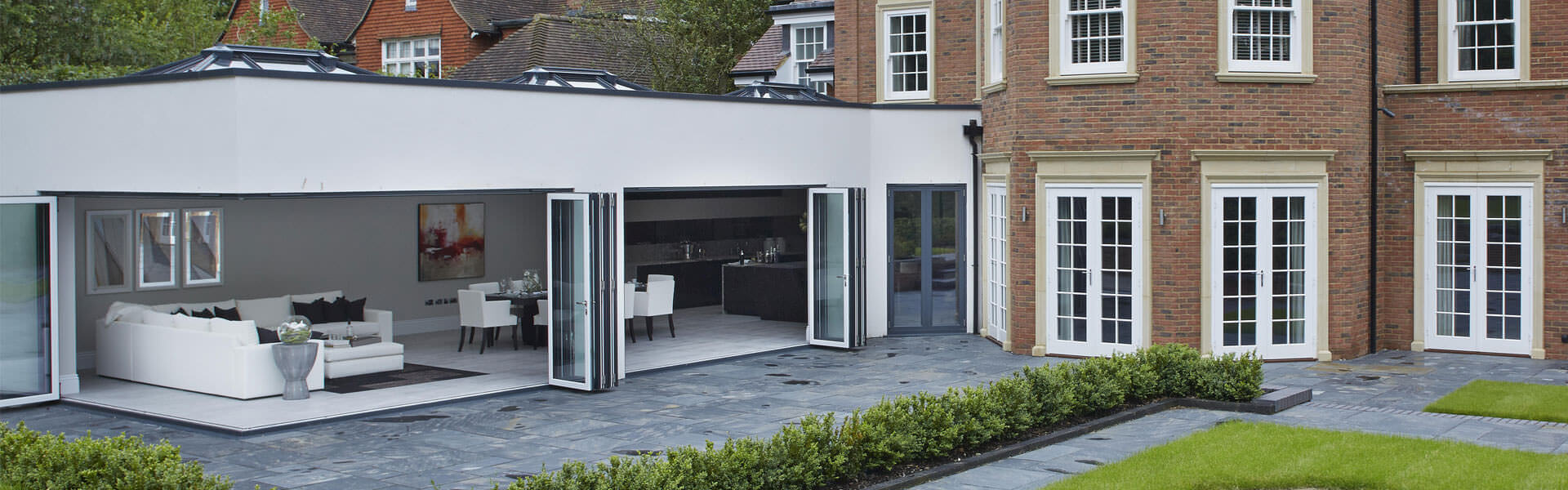
Bi-folds, clearly. Fold the panels back and you are left with the frames stacked to one or both sides, so the great majority of the opening is walk-through. It is the closest you get to removing the wall.
A two-panel slider opens to roughly half the aperture. A three-panel slider on two tracks opens to around two thirds. If your priority is a genuinely open threshold for entertaining, bi-folds do it better.
Which one looks better when they are shut?
Sliding doors, for most people. This is the trade-off that surprises homeowners most, so it is worth being blunt about it.
A bi-fold needs a frame around every panel, because every panel is a door. A four-panel bi-fold therefore puts four sets of frames across your view. A slider spanning the same opening might use two panes, so you see far less aluminium and far more garden. If the doors face a view you look at every day through the winter, that matters more than the summer opening does.
Bi-fold and sliding doors compared
| Bi-fold doors | Sliding doors | |
| How much opens | Most of the aperture | Half to about two thirds |
| View when closed | A frame at every panel | Fewer, wider panes |
| Panel width | Narrower panels | Wider, heavier panes |
| Where the doors go | Stack back into the room or outside | Stay within the opening |
| Everyday access | Usually a single traffic door | Slide one panel |
| Suits | Opening the whole wall in summer | Maximum glass and a slim, quiet look |
How much space do the doors need?
This is the practical question people forget, and it is usually what settles the decision.
A bi-fold's panels have to go somewhere. Stacked internally they project into the room and take up the return wall beside the opening, so furniture cannot sit there. Stacked externally they project onto the patio, which is fine if there is depth and awkward if the paving is narrow or there is a step.
Sliding doors stay inside the opening. Nothing projects, nothing swings, and the space either side stays usable. In a tight room, or where the patio is shallow, a slider is often the only sensible answer regardless of which you prefer aesthetically.
Which is easier to use day to day?
Sliding doors, for ordinary in-and-out use. You move one panel and step through. Bi-folds are typically specified with a traffic door, a single leaf that opens on its own like a normal door, precisely because folding the whole set back is not something you want to do to let the dog out.
If you expect to open the doors fully only a handful of times a year, be honest about that when choosing. Plenty of people buy a bi-fold for the two weeks of summer and use the traffic door for the other fifty.
Which is more secure?
Both are specified with multi-point locking, and in aluminium both are inherently strong. Sliding doors have fewer opening joints simply because there are fewer panels, while bi-folds have a lock engagement at each panel.
Security is determined by the hardware and the system specified rather than by the format, so it is a question to settle on the individual quote rather than in the abstract. Ask what locking is included and what the glazing specification is, on whichever you choose.
What drives the cost?
Neither format is automatically cheaper. Cost is driven by the size of the opening, the number of panels, the glass specification, the colour finish, and the structural work needed above the opening, not by whether the doors fold or slide.
As a rule of thumb, a bi-fold uses more frame and more hardware for a given width, while a slider uses larger and heavier panes of glass. Those two things pull in opposite directions, which is why a like-for-like quote is the only reliable comparison. We are happy to price both for the same opening so you can see the difference for your project rather than in general.
So which should I choose?
Choose bi-fold doors if the reason you are doing this is to open the room up onto the garden, you have somewhere sensible for the panels to stack, and you accept the extra frames in the closed view.
Choose sliding doors if the view matters more than the opening, the room or patio is tight on space, you want the largest possible panes, or the doors face something you want to look at all year.
Still not sure? Stand in the room and ask how often you will realistically have the doors fully open. If the honest answer is "a few weekends", the closed view is what you are actually buying, and that points at a slider.
Common questions
Can you have a bi-fold door that opens both ways?
Yes. Bi-folds can be configured to stack entirely to one side, or to split and stack to both sides of the opening. The split configuration is useful where you want a clear route out through the middle.
Do sliding doors have a step?
Both bi-fold and sliding systems are available with low or flush threshold options, which matters for level access and for wheelchairs or pushchairs. The threshold detail has to be planned with the floor build-up and the drainage outside, so raise it early rather than at installation.
Which is better for a narrow opening?
For a narrow opening a sliding door often makes more sense, because a bi-fold split into several panels across a small width gives you a lot of frame and not much glass. Below a certain width, a single French or patio door may serve better than either.
Do you supply both?
Yes. We supply and install both aluminium bi-fold doors and aluminium sliding and patio doors across East and West Sussex, and we are glad to quote both formats for the same opening.
Talk it through with us
The right answer depends on your opening, your room and how you will actually use the doors, which is why we survey before quoting. If you would like both options priced, get in touch or call us on 01293 226523.
Related reading: why choose aluminium doors over uPVC, and our comparison of aluminium and uPVC bi-fold doors.