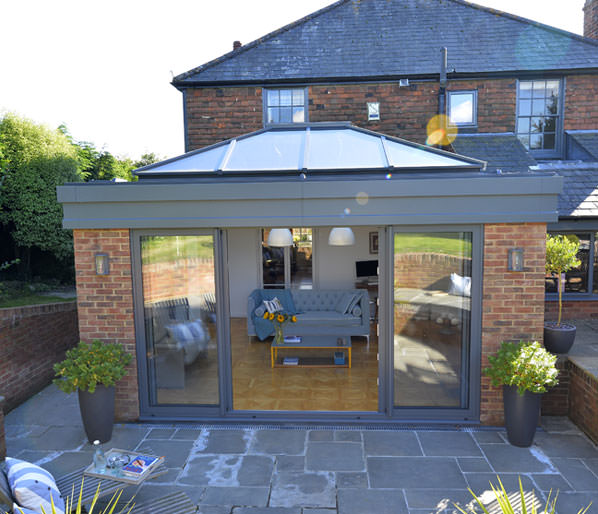
Why Choose Aluminium Doors?
25 November 2016 · Updated 12 August 2026The short answer: aluminium is stronger than uPVC, so the frames can be much slimmer for the same size of door. That means more glass, wider spans and a sharper look, with a colour finish that does not yellow. uPVC is the cheaper material and still a sensible buy on smaller openings, which is why we fit both.
This is the material question rather than the product question. If you have already settled on bi-folds and want the two materials compared for that specific product, read aluminium versus uPVC bi-fold doors. If you are choosing between door formats, read bi-fold or sliding doors.
What is the real difference between aluminium and uPVC?
Strength per millimetre of frame. Aluminium is a structural metal, so a slim aluminium section can carry a large, heavy pane. uPVC is a plastic and needs more bulk, and usually a steel or reinforced core, to do the same job.
Everything else follows from that. Slimmer frames mean more glass in the same hole in the wall. Greater strength means larger single panels and wider overall spans before you need an extra mullion. It also means the frame holds its shape over a long life without the flex you can get in a large plastic section.
Aluminium and uPVC doors compared
| Aluminium | uPVC | |
| Frame width | Slim sightlines | Chunkier sections |
| Glass area | More glass for the same opening | Less glass for the same opening |
| Maximum span | Larger panels and wider openings | More limited before extra frames |
| Finish | Powder coated, holds colour | Can yellow with UV over time |
| Colour range | Full RAL range, dual colour possible | More limited, often foiled |
| Cost | Higher | Lower |
| Best suited to | Large openings, big glass, long life | Smaller openings on a tighter budget |
Which gives you more glass?
Aluminium, and the difference is visible rather than technical. Put an aluminium and a uPVC door of the same overall size side by side and the aluminium one has noticeably more glass, because the frames eating into the aperture are narrower.
On a single door the difference is modest. Across a wide bi-fold or a large slider it becomes the main thing you notice, because the frame width is repeated at every panel.
When is uPVC actually the better choice?
We fit both, so it is worth saying plainly where uPVC wins.
- Budget is the deciding factor. uPVC costs less. If the choice is a good uPVC door now or an aluminium one in three years, fit the uPVC door.
- The opening is small. On a standard back door or a modest French door, the slim-sightline advantage is worth much less, because there is not much frame either way.
- The door is out of sight. A side return or utility door that nobody looks at is a sensible place to save money for the front of the house.
- You are matching existing uPVC. If the rest of the house is white uPVC and you are replacing one door, matching may look better than mixing materials.
Our uPVC doors use the Liniar system, and we also supply uPVC windows. We would rather fit you the right thing than the more expensive thing.
What about colour and finish?
Aluminium is powder coated, which means colour is a finish bonded to the metal rather than a plastic that is coloured throughout or covered with a foil. Practically, that gives you a very wide RAL colour range, a consistent finish on large sections, and the option of one colour outside and a different one inside, which is useful when the exterior needs to suit the house and the interior needs to suit the room.
Powder coating also holds its colour under UV. Older white uPVC has a reputation for yellowing over many years, and while modern uPVC is better than it was, it remains a plastic exposed to sunlight.
How much maintenance do aluminium doors need?
Very little. Wash the frames down with warm soapy water a few times a year, keep the tracks and drainage channels clear of grit and leaves, and keep the moving parts and locks lubricated as the manufacturer advises. Aluminium does not rot, warp or need painting.
The parts that need attention on any door, in either material, are the moving ones. Hinges, rollers, gaskets and locks are what wear, and keeping the tracks clean does more for the life of a sliding or bi-fold door than anything else you can do.
How long do aluminium doors last?
A well-specified aluminium door is a long-term fixture rather than a ten-year purchase. The frame material itself is extremely durable, and the finish is designed to hold up outdoors.
Guarantee terms vary by system and by component, and frames, glass units and workmanship are not always covered for the same period. Rather than quote a single figure here, we set out the exact terms that apply to your system on your quotation, so you can see what is covered and for how long before you commit.
Are aluminium doors thermally efficient?
Modern architectural aluminium doors are thermally broken, meaning the inner and outer parts of the frame are separated by an insulating barrier so the metal does not simply conduct heat straight out of the building. Combined with modern double or triple glazed units, that is what makes aluminium viable for large areas of glass.
Performance depends on the specific system, the glass unit and the size of the door, so the figure that matters is the one on your quotation for your door, not a general claim. Ask for it and compare like with like when you are getting more than one price.
Common questions
Are aluminium doors worth the extra cost?
On a large opening, usually yes, because that is where the slim frames, the extra glass and the wider spans actually show. On a small back door the case is weaker and uPVC may be the better value.
Do aluminium doors suffer from condensation?
Thermally broken aluminium frames are designed to keep the internal frame surface warm enough to avoid the condensation that untreated metal frames used to suffer from. Condensation on the room side is usually about humidity and ventilation rather than the door itself.
Can aluminium doors be any colour?
Powder coating covers a very wide RAL range, and different colours inside and out are possible. See our colour options and finishes.
Do you fit both aluminium and uPVC?
Yes. We supply and install aluminium doors and Liniar uPVC doors, so we have no reason to push you towards one material over the other.
Talk it through with us
We install across East and West Sussex from our workshop at Piltdown, near Uckfield. If you would like both materials priced for the same opening, get in touch or call 01293 226523.
More on the range: bi-fold doors, sliding and patio doors, front doors and aluminium windows.