U-Values Explained: Reading the Numbers on Your Glazing Quote
12 August 2026The short answer: a U-value measures how quickly heat escapes through a part of the building. It is written in W/m²K, and lower is better. A window with a U-value of 1.2 loses heat more slowly than one at 1.6.
That single sentence is most of what you need. The rest of this page is about the traps: which U-value you are being quoted, why two quotes with different numbers may not be comparable, and what actually changes the figure.
What does a U-value actually measure?
It is the rate at which heat passes through one square metre of a building element for each degree of temperature difference between inside and outside. The units, W/m²K, say exactly that: watts, per square metre, per kelvin of difference.
Because it is a rate of loss, a smaller number is a better performing product. This catches people out, because in most of life a bigger number sounds better.
Whole-window, centre-pane or glass-only?
This is the one that matters when you are comparing quotes, and it is where numbers stop being comparable.
- Centre-pane U-value describes only the middle of the glass unit, away from the edges and the frame. It is always the most flattering figure.
- Whole-window U-value describes the complete product as installed: glass, edge spacer and frame together, in the proportions of an actual window. It is the honest number.
A quote showing a very low figure may be quoting centre-pane while another shows whole-window and looks worse on paper while actually being the better window. Always ask which figure you are being given, and compare like with like. If a quotation does not say, that is worth a question.
What changes the number?
The glass unit
Double or triple glazing, the gap between panes, the gas fill, and low-emissivity coatings all move the figure. The low-E coating is doing more work than most people realise: it reflects heat back into the room while letting light through.
The spacer bar
The bar separating the panes around the edge of the unit is a heat path. A warm-edge spacer performs better than a traditional aluminium one, and it shows up in the whole-window figure while being invisible in the centre-pane one.
The frame
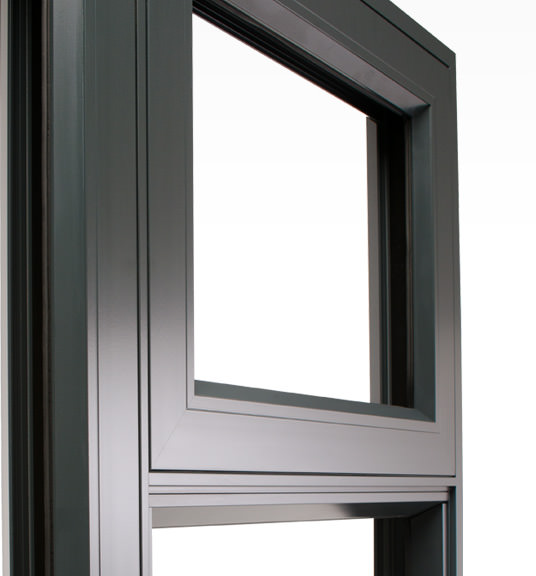
Metal conducts, so an aluminium frame has to be thermally broken: the inner and outer sections are separated by an insulating barrier so heat cannot travel straight through the metal. All modern architectural aluminium works this way, and it is what makes large aluminium glazing viable.
The size and shape
This surprises people. Because the frame usually performs worse than the middle of the glass, a large pane with proportionally less frame often has a better whole-window U-value than a small one made from the same system. A door split into many narrow panels has more frame in it than a slider with two large panes.
What is a good U-value?
The threshold that matters legally is the one in the current Building Regulations for your situation, and it differs between a replacement window in an existing house and a new extension. That figure is set by government and changes over time, so rather than print a number here that may be out of date when you read it, we confirm the requirement that applies to your job and the figure the specified product achieves, in writing, on your quotation.
If you want to check independently, your building control body or the current Approved Document is the authority, not an installer's website.
Is a lower U-value always worth paying for?
Not automatically. Improving the U-value costs money, and the benefit depends on how much glass you have, which way it faces, and how the room is used. On a large north-facing elevation the case is strong. On a small utility window it is weak.
There is also a trade-off people forget: measures that reduce heat loss can also reduce solar gain, which is free winter heat. On a south-facing room you may want to think about solar control and overheating as carefully as about heat loss. The right answer is per-elevation, not per-house.
What else appears on a glazing quote?
You may see a window energy rating band, which combines heat loss with solar gain and air leakage into a single letter. It is a useful summary but it hides the detail, so treat it as a headline and ask for the U-value underneath it.
You may also see a g-value, which describes how much solar energy the glass lets through. Higher means more free heat in winter and more overheating risk in summer. It is the number to discuss for roof glazing and south-facing walls.
Common questions
Is triple glazing always better than double?
It generally gives a lower U-value, but it is heavier, costs more and reduces solar gain. Whether it is the right choice depends on the opening, the orientation and what else in the building fabric is losing heat. It is worth pricing rather than assuming.
Why do two quotes show different U-values for a similar door?
Usually because one is centre-pane and the other whole-window, or because the glass specification differs. Ask both suppliers which figure they have given and for the same basis before drawing a conclusion.
Does the U-value tell me about draughts?
No. U-value is about heat conducted through the product. Draughts are air leakage, which is a separate measurement and, in practice, largely down to the quality of the installation and the sealing around the frame.
What U-value do your products achieve?
It depends on the system, the glass specification and the size of the unit, so we state the figure for your actual specification on your quotation rather than quoting a general number here.
Ask us for the figure in writing
Whoever you buy from, ask for the whole-window U-value for the specification you are being quoted, in writing. It makes competing prices genuinely comparable. Get in touch or call 01293 226523.
Related: why choose aluminium, our aluminium window range and roof lanterns.